Browser Access to Nano Banana, Seedream, and GPT Image—Model Sources Explained
How ImageGenerator.app provides browser access to Nano Banana, Seedream, and GPT Image—with model provenance, compliance disclaimers, and access-path tradeoffs.
 ImageGenerator Team

ImageGenerator.app is an independent, cloud-hosted browser playground designed to provide digital artists, visual designers, marketing teams, and developers with unified, on-demand access to premier visual generative artificial intelligence models. Without requiring local hardware upgrades, software installations, driver dependencies, or individual third-party developer API keys, creators can interact directly with leading foundation architectures—including Nano Banana, Seedream, and the GPT Image family—from any modern web browser.
As generative vision models rapidly proliferate, discerning the origins, capabilities, and governance structures of these systems becomes essential. Modern foundation architectures differ fundamentally in their underlying neural networks, training paradigms, prompt tokenization schemes, and commercial licensing boundaries. Navigating these platforms often entails dealing with fragmented developer portals, complicated cloud consoles, waitlists, and conflicting billing structures.
ImageGenerator.app resolves this operational fragmentation by abstracting backend infrastructure into an accessible, unified workspace. However, providing frictionless browser access requires complete transparency regarding technological provenance and regulatory boundaries. This guide clarifies the operational relationship between ImageGenerator.app and underlying model creators, maps each featured engine to its authentic technological lineage, breaks down the realities of browser-based cloud inference, and provides an objective framework for selecting models without relying on misleading benchmark shootouts.
Compliance and Disclaimer: Operational Reality of a Third-Party Playground
Before examining technical architectures or exploring creative workflows, it is crucial to establish the legal, technical, and operational posture of ImageGenerator.app:
- Independent Third-Party Hosted Service: ImageGenerator.app is an independent third-party web application. It is not an official application, proprietary software release, direct subsidiary, or joint venture of Google DeepMind, ByteDance, OpenAI, or any other foundation model developer. The platform operates strictly as an independent orchestration layer connecting browser users to enterprise inference endpoints.
- Provider Ownership and Training Attribution: ImageGenerator.app does not train these base foundation models. The neural network weights, foundational architectures, multi-billion-parameter transformer backbones, multimodal pre-training corpuses, and proprietary alignment algorithms are developed, trained, and owned solely by their respective research institutions and parent corporations. ImageGenerator.app does not claim authorship, proprietary ownership, or training credit for any base foundation model.
- Non-Exclusive Access Layer: ImageGenerator.app is not the exclusive portal, nor does it possess proprietary exclusivity for any model available in its directory. Every foundation model accessible through the platform can also be reached through its creators' respective developer APIs, enterprise cloud platforms, or official research hubs.
- Trademarks and Brand Attribution: All product names, company names, trademarks, registered marks, and logos referenced across ImageGenerator.app and this article are the property of their respective trademark holders. Mention of third-party organizations, model families, or research entities does not imply any sponsorship, endorsement, formal partnership, or commercial affiliation.
- Platform Terms and Governance: All generations, prompt submissions, and user activities conducted on the platform are governed by platform policies. For comprehensive acceptable use policies, community safety rules, data processing terms, and user guidelines, review our official Terms of Service and learn more on our About Us page.
Model Provenance Map: Provider Attribution and Architectures
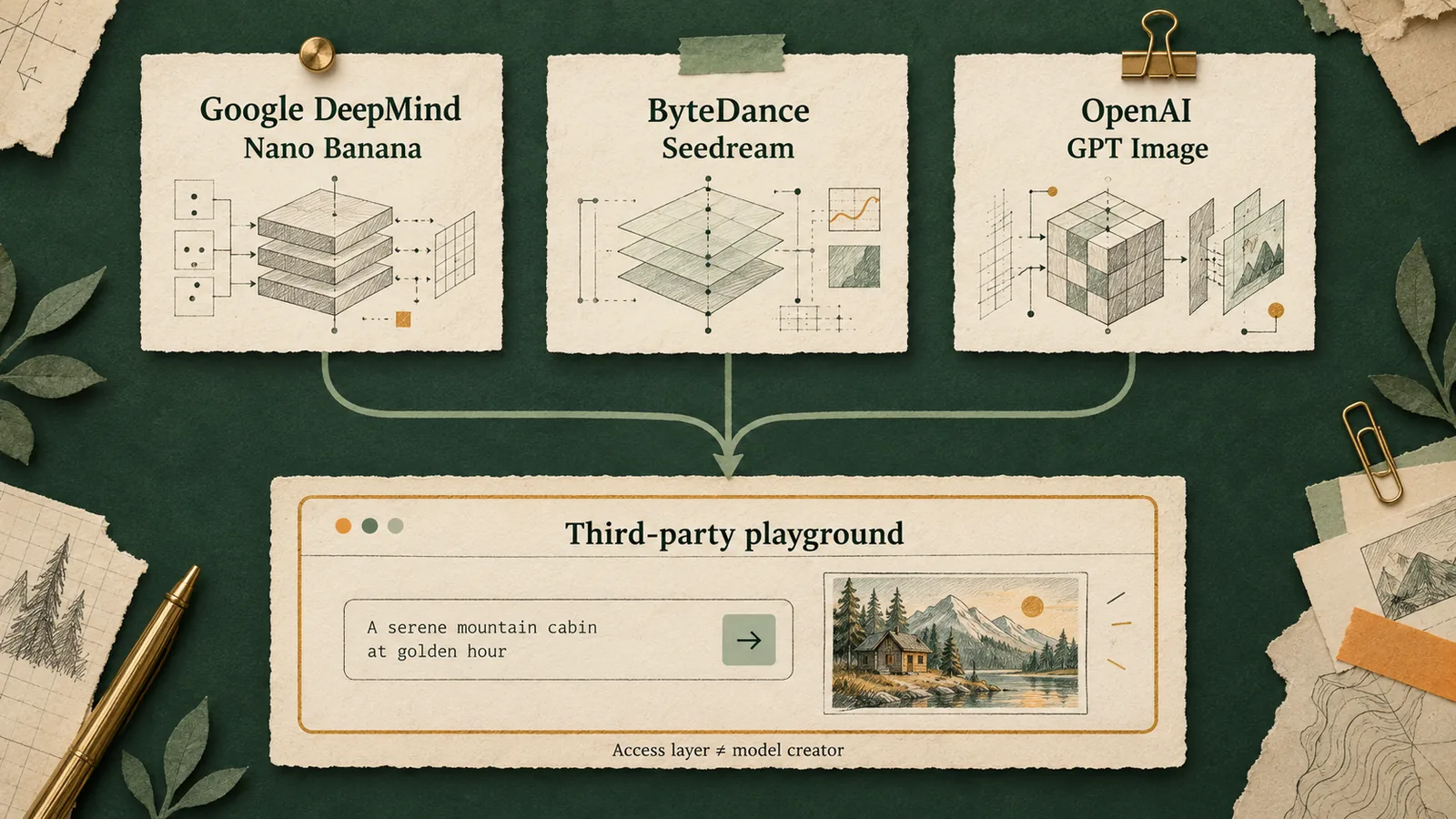
To ensure complete transparency regarding model origins, the table below maps each generative engine available on ImageGenerator.app to its originating research organization, technological family, and dedicated technical documentation page.
| Playground Model Name | Originating Provider / Research Lab | Model Family & Technological Origin | Playground Model Directory |
|---|---|---|---|
| Nano Banana / Nano Banana Pro | Google DeepMind | Gemini image generation family | Nano Banana Overview |
| Seedream / Seedream Series | ByteDance | ByteDance visual intelligence family | Seedream 5.0 Pro |
| GPT Image / GPT Image Series | OpenAI | DALL·E / GPT visual generation family | GPT Image 2 |
You can explore our complete and regularly updated catalog of active foundation models, experimental checkpoints, and interface tools directly within the Models Directory. Every listing provides technical specifications, recommended aspect ratios, and architectural overviews.
In-Depth Architectural Lineage: Demystifying the Foundation Models
Understanding model origins helps creators choose the right engine for their goals. Each model family reflects the distinct engineering priorities and architectural philosophies of its originating research lab.
1. Google DeepMind: The Gemini Image Family (Nano Banana)
Google DeepMind is recognized for multimodal transformers and computational intelligence. In generative media, Google transitioned from standalone diffusion models to unified multimodal architectures that process visual and language tokens jointly.
On ImageGenerator.app, Nano Banana and Nano Banana Pro provide access to Google DeepMind's Gemini image family. According to on-site model pages at Nano Banana Overview, the architecture offers distinct strengths:
- Multimodal Semantic Grounding: Deep multimodal encoders accurately interpret complex spatial prepositions (e.g., "perched atop the weathered copper cupola behind the primary bell tower") and hierarchical scene relationships.
- Complex Scene Geometry: Preserves realistic perspective and geometric proportions across complex scenes, minimizing visual collisions between interacting subjects.
- Contextual Nuance: Draws on broad language training to interpret specialized architectural, historical, and botanical terminology without requiring extensive prompt circumlocution.
Creators requiring precise spatial arrangements and clean contextual execution often choose Nano Banana for structural compositions and detailed mockups.
2. ByteDance Visual Intelligence: The Seedream Series
ByteDance's visual computing divisions specialize in high-throughput video processing, computer vision, and dynamic visual generation. ByteDance's generative research focuses on visual aesthetic appeal, vibrant color science, and expressive rendering.
Hosted on ImageGenerator.app, the Seedream series represents ByteDance's visual intelligence family. According to on-site model pages at Seedream 5.0 Pro, this family delivers:
- Aesthetic Polish & Color Grading: Pre-trained on aesthetically curated datasets, Seedream delivers balanced contrast, specular highlights, and rich shadows without requiring extensive prompt modifiers.
- Stylistic Versatility & Concept Art: Excels across digital concept art, painterly watercolor, and editorial illustrations, retaining tactile surface textures like impasto strokes and film grain.
- Dynamic Framing: Staging dramatic angles, foreshortening, and expressive facial framing, avoiding rigid portrait staging.
For illustrators, worldbuilders, and creative directors seeking mood-driven key art, Seedream serves as a powerful creative engine bringing emotional resonance to the canvas.
3. OpenAI: The GPT Image Family
OpenAI pioneered commercial generative AI, fundamentally altering generative art with DALL·E and subsequent GPT visual architectures. These systems demonstrated that pairing deep natural language processing models with diffusion transformers could democratize visual synthesis.
On ImageGenerator.app, the GPT Image series incorporates OpenAI's visual generation architectures. According to on-site model pages at GPT Image 2, key strengths include:
- Literal Prompt Adherence: Follows complex, multi-clause instructions with strict fidelity, minimizing attribute leakage where colors or textures accidentally bleed into adjacent objects.
- Legible Text Rendering: Features robust internal text representations, allowing the model to render short, legible signage, labels, and callouts directly within generated scenes.
- Metaphorical & Conceptual Synthesis: Handles abstract concepts, philosophical allegories, and surreal juxtapositions effectively, translating metaphorical ideas into coherent visual scenes.
When your workflow requires exacting instruction following, typography, or surreal concepts, GPT Image provides a reliable, articulate foundation.
The Access Dilemma: Local Deployment vs. Raw APIs vs. Hosted Web Playgrounds
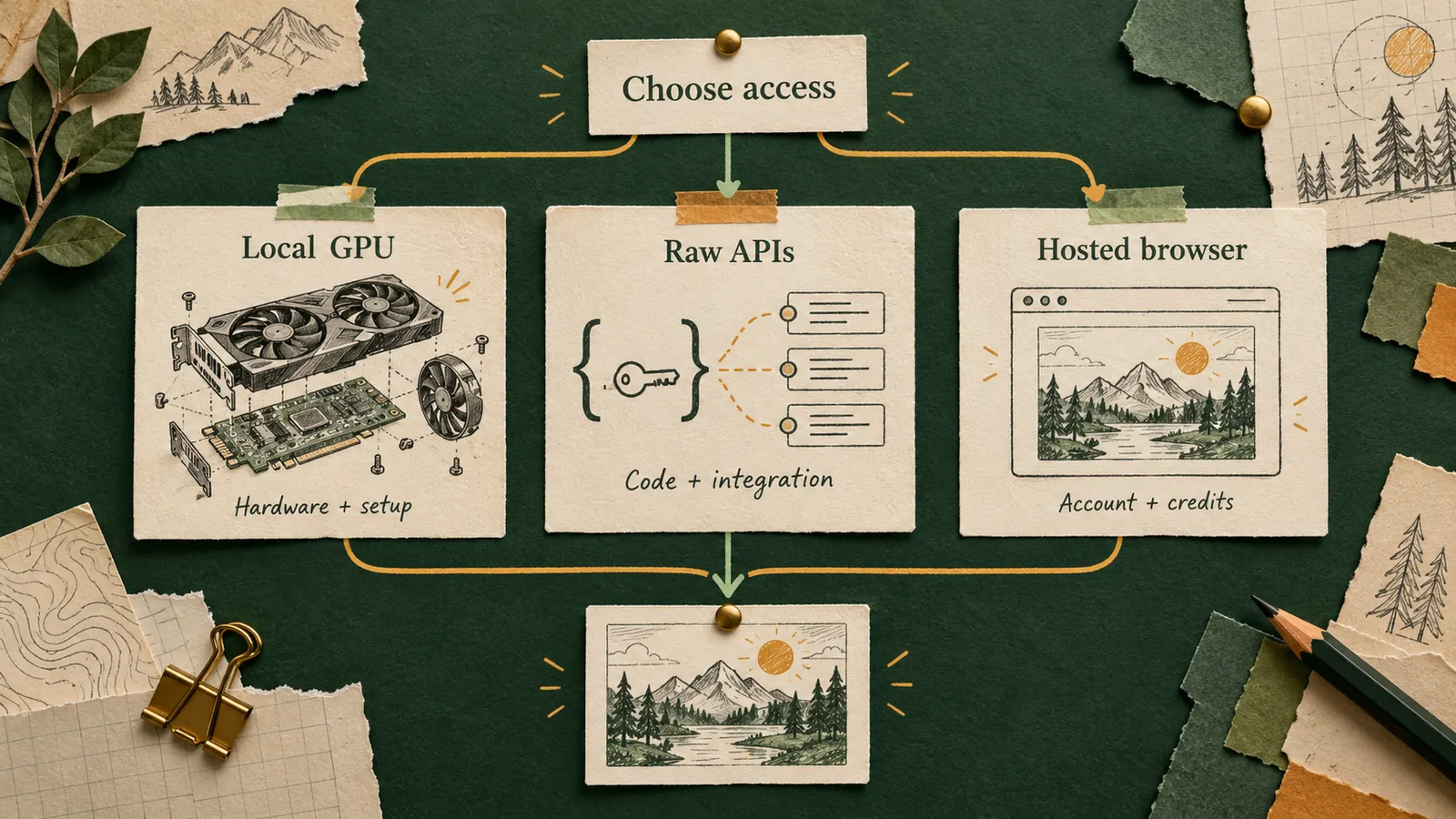
To appreciate why a hosted browser playground is valuable in modern creative pipelines, examine the friction associated with traditional deployment paths:
Paradigm 1: Local Self-Hosting (Hardware and Maintenance Overhead)
Local execution offers power users control over pipelines, but contemporary multi-billion-parameter image models impose severe barriers:
- GPU and VRAM Demands: High-fidelity architectures demand 16GB, 24GB, or dual 32GB+ workstation GPUs to prevent out-of-memory crashes or quantization penalties.
- Software Stack Maintenance: Managing Python environments, PyTorch versions, CUDA toolkits, ROCm drivers, and node graph tools requires ongoing maintenance; system updates frequently break dependencies.
- Storage Bottlenecks: Model weights, latent variational autoencoders (VAEs), and text encoders consume 10GB to 50GB per model, overwhelming consumer drives.
- Proprietary Model Inaccessibility: Leading foundation models—including Google DeepMind's Gemini image models and OpenAI's GPT Image architectures—are proprietary cloud models not distributed for local hosting.
Paradigm 2: Direct Foundation Provider APIs (The Developer Burden)
Direct API integration provides raw programmatic access, but creates substantial overhead for visual creators and designers:
- Fragmented Billing Accounts: Accessing models across Google, OpenAI, and ByteDance requires maintaining separate developer accounts, minimum credit commitments, and recurring reconciliations.
- API Key Security Risks: Handling raw API keys introduces real vulnerabilities; accidental repository commits or client exposure can trigger thousands of dollars in unauthorized compute.
- Schema Divergence: Each provider enforces distinct API parameters for resolutions, aspect ratios, and sampling steps, necessitating continuous code updates.
- Rate Limits: Default developer tiers enforce strict rate limits (e.g., 2 to 5 requests per minute), stalling iterative creative sprints.
Paradigm 3: Hosted Browser Playgrounds (ImageGenerator.app)
Hosted browser playgrounds abstract cloud infrastructure and model orchestration behind a clean interface:
- Zero Local Hardware Footprint: Compute executes on high-performance cloud clusters; any standard laptop, Chromebook, or tablet generates visuals with identical speed.
- Zero Software Installation: The workspace runs natively in standard browsers without Python environments, terminal scripts, or local drivers.
- No Individual Provider API Keys Required: Users avoid developer consoles, secret tokens, and provider billing setup; the platform orchestrates backend connections.
- Unified Prompting Interface: Switch foundation models directly inside the prompt container in the text-to-image workspace while preserving prompt text, negative constraints, and aspect ratios.
Under the Hood: The Lifecycle of a Browser-Based Generation Request

To understand how ImageGenerator.app delivers rapid inference across distinct foundation models without local hardware, consider the architectural journey of a single prompt:
1. Client-Side Input Capture
In the text-to-image interface, creators define their prompt, negative constraints, aspect ratio (1:1, 16:9, 9:16), and target engine. The interface validates parameters locally before submission.
2. Secure Transmission and Orchestration Handshake
Clicking Generate transmits an encrypted payload to the orchestration gateway over HTTPS/WSS protocols, verifying account sessions, checking credits, and allocating compute.
3. Policy and Safety Screening
Before reaching model clusters, requests pass through multi-tiered moderation filters, ensuring compliance with platform Terms of Service and provider safety standards. Policy-violating inputs are rejected prior to compute consumption.
4. Dynamic Payload Serialization
Every foundation model family requires a unique API schema: Google DeepMind endpoints require multimodal JSON structures; ByteDance endpoints process custom sampling parameters; and OpenAI endpoints require specific dimension schemas. ImageGenerator.app translates playground inputs into each provider's exact specification.
5. High-Performance Cloud Execution
Serialized requests route to distributed enterprise GPU clusters. The foundation engine executes multi-step diffusion or generative decoding, synthesizing latent representations from text embeddings.
6. Post-Processing, Caching, and CDN Delivery
The gateway processes output buffers, applies lossless format optimization, caches assets on a global CDN, and delivers the finalized render directly to your canvas for inspection or iteration.
Dynamic Credit Billing: Transparent Resource Consumption
In cloud-hosted generative AI, computational demands vary across models, resolutions, and rendering pipelines. Generating a standard 1024x1024 image on an optimized architecture requires far less GPU time than rendering ultra-high-resolution assets with a dense foundation transformer.
Why Credit Costs Are Dynamic
Rather than imposing an artificial flat rate that overcharges for lightweight runs or risks platform stability, ImageGenerator.app utilizes dynamic credit billing based on:
- Parameter Scale: Larger multi-billion parameter architectures require larger GPU memory allocations.
- Resolution Multipliers: Widescreen or tall aspect ratios increase the latent pixel matrix, requiring more tensor computation during denoising.
- Inference Compute Intensity: Extended sampling trajectories and multi-pass refining steps translate directly into backend server execution time.
The Playground Rule: Always Inspect the Live Credit Display
To ensure complete financial transparency:
Important: We never hardcode or advertise static credit numbers in informational guides, because model versions, compute optimizations, and provider backend tariffs evolve. Instead, the platform displays the exact, live credit cost directly beside the Generate button in the playground interface.
Before generating, verify the credit label beside the Generate button in the text-to-image workspace. As you switch between Nano Banana, Seedream, and GPT Image, or change aspect ratios, the credit label updates dynamically in real time. For package options, visit the Pricing Page.
Beyond the Hype: Model Specialization Over Arbitrary Shootouts
The generative AI community frequently organizes "side-by-side prompt shootouts," pasting identical text into multiple engines to crown a single "winner." While entertaining, this approach is fundamentally misleading for production workflows.
The Problem With Identical-Prompt Comparisons
Foundation models do not share identical text encoders or training distributions:
- Text Encoder Differences: A model driven by a dense T5-XXL language encoder thrives on descriptive, grammatically structured prose and spatial relationships. Conversely, a dual CLIP ViT-L model responds best to comma-separated tags and medium keywords. Feeding prose into CLIP risks truncation; feeding terse tags into a multimodal encoder underutilizes its reasoning capacity.
- Stylistic Priors: Each model is aligned on different aesthetic distributions. An engine trained for cinematic contrast interprets simple prompts with dramatic lighting, while a model aligned for photorealism produces neutral documentary framing. Neither is objectively superior; they serve different creative intents.
Selecting Engines by Creative Intent
Rather than searching for a universal best model, match the architecture to your specific project needs:
- Choose Nano Banana (Google DeepMind / Gemini image family) for scenes requiring strict perspective geometry, spatial positioning between subjects, and detailed contextual interpretation.
- Choose Seedream (ByteDance visual intelligence family) for visual drama, vibrant color balance, painterly textures, digital concept art, and cinematic character staging.
- Choose GPT Image (OpenAI family) for strict literal adherence to multi-clause instructions, legible integrated signage, and surreal conceptual synthesis.
For in-depth prompt engineering techniques and comparative model evaluations, explore our comprehensive guide on Choosing an AI Image Model.
Safety, Moderation, and Acceptable Use Governance
Operating a multi-model generative playground requires strict adherence to content safety standards, regulatory guidelines, and intellectual property protections. ImageGenerator.app implements layered governance to protect users and creators:
Multi-Tiered Content Moderation
Every generation passes through multiple safety checkpoints:
- Pre-Inference Moderation: Automated text classifiers evaluate prompts for prohibited categories, including CSAM, non-consensual sexual content, self-harm, violence, and dangerous instructions, blocking violations before compute allocation.
- Provider Native Filtering: Inference clusters operated by Google DeepMind, ByteDance, and OpenAI apply secondary proprietary guardrails to prevent harmful visual generation.
- Post-Inference Image Scanning: Computer vision filters scan generated image buffers to redact unintended explicit artifacts before canvas rendering.
Commercial Usage and Intellectual Property Guidelines
Professional creators should observe key legal and commercial considerations:
- Ownership of Generated Assets: ImageGenerator.app claims no proprietary ownership, copyright, or licensing rights over user-generated images. Subject to our Terms of Service and provider terms, users retain rights granted under applicable law.
- Provider Commercial Terms: Foundation providers generally permit commercial outputs that comply with acceptable use policies. However, licensing terms vary across model families; verify terms via our Terms of Service and on-site model pages.
- Copyright Considerations: In jurisdictions including the United States, purely machine-generated visual works lacking sufficient human creative authorship may not qualify for statutory copyright protection. Combining generative outputs with original manual artwork or graphic design provides stronger proprietary standing.
- Prohibited Use: Generating deceptive deepfakes, non-consensual likenesses of private individuals, fraudulent documents, or infringing trademarks is strictly prohibited.
Practical Workflow: A Step-by-Step Guide to Multi-Model Generation
To maximize creative efficiency across diverse foundation models, use this streamlined workflow on ImageGenerator.app:
Step 1: Browse the Model Directory
Visit the Models Directory to review active models, technical lineages, and documentation—including the Nano Banana Overview, Seedream 5.0 Pro, and GPT Image 2—to check revisions and prompt recommendations.
Step 2: Open the Unified Text-to-Image Workspace
Navigate to the text-to-image workspace to access a consolidated canvas and prompt container without tab switching.
Step 3: Compose Your Foundation Prompt
Draft your visual description within the primary prompt box:
- Define the primary subject clearly (e.g., "an antique bronze astrolabe with etched astrological glyphs").
- Specify the environment and lighting (e.g., "resting on an oak cartographer's desk, illuminated by warm candlelight and soft moonlight").
- Set the framing and medium (e.g., "macro photography, shallow depth of field, sharp focus on central dials").
Step 4: Select Your Foundation Engine and Parameters
Choose your initial engine from the model dropdown and set your aspect ratio (e.g., 16:9 widescreen or 9:16 vertical).
Step 5: Check the Live Credit Indicator
Observe the dynamic credit cost displayed directly beside the Generate button, confirming resource allocation before initiating inference.
Step 6: Generate and Iterate Within the Same Prompt Box
Click Generate to render your visual. To evaluate an alternate model's interpretation, keep your prompt and aspect ratio intact, switch the dropdown from Nano Banana to Seedream or GPT Image, verify the updated credit label, and click Generate again.
Step 7: Export and Archive
Download your finalized high-resolution PNG or WebP assets. Generations remain accessible in your session history for review and export.
Frequently Asked Questions (FAQ)
Is ImageGenerator.app an official application of OpenAI, Google DeepMind, or ByteDance?
No. ImageGenerator.app is an independent, third-party hosted playground. It is neither owned by, sponsored by, endorsed by, nor directly affiliated with OpenAI, Google DeepMind, ByteDance, or their corporate subsidiaries. All product names, logos, and trademarks belong to their respective holders.
Does ImageGenerator.app train or fine-tune its own base foundation models?
No. ImageGenerator.app does not train base foundation models, nor does it claim proprietary ownership of their weights. The Gemini image family (Nano Banana), the ByteDance visual intelligence family (Seedream), and the OpenAI visual family (GPT Image) are researched, trained, and updated exclusively by their originating organizations. ImageGenerator.app operates as a cloud orchestration and browser interface layer.
Is ImageGenerator.app the only place where I can access Nano Banana, Seedream, or GPT Image?
No. ImageGenerator.app does not hold exclusive access to any foundation model. Creators can also access these models via official developer consoles, cloud computing APIs, or research platforms. ImageGenerator.app provides an accessible alternative for users who prefer an interactive, no-code web environment.
Why should I use a hosted web playground instead of setting up my own developer API keys?
Direct developer API integration requires managing separate billing profiles, upfront credit commitments, secure key storage, custom integration code, and endpoint deprecations. ImageGenerator.app eliminates this complexity: open your browser, enter your prompt, select an engine, and generate immediately without managing private API credentials.
Why aren't generation credit costs fixed in this guide?
Compute costs vary by model parameter count, output resolution, aspect ratio, and sampling intensity. Furthermore, backend infrastructure tariffs change over time. To ensure complete billing accuracy, ImageGenerator.app calculates credit requirements dynamically. Always check the live credit cost displayed directly beside the Generate button before submitting a prompt. For credit replenishment, visit our Pricing Page.
Can I use the images I generate for commercial projects and client deliverables?
Leading foundation model providers generally permit commercial usage of outputs that comply with acceptable use policies. ImageGenerator.app claims no ownership over your generated assets. However, commercial rights and copyright regulations vary across jurisdictions and model families. Review our Terms of Service and consult on-site model documentation before commercial deployment.
Are my prompts and generated images used to train foundation AI models?
ImageGenerator.app routes requests through enterprise cloud gateways designed to safeguard data integrity and creative privacy. We do not use user generations or prompt inputs to train foundation models. For details on data retention and caching, review our Terms of Service.
How do I know which foundation model to choose for my specific prompt?
Model selection depends on your project goals. Choose Nano Banana for intricate spatial geometry and complex scene descriptions. Choose Seedream for vibrant color harmony, cinematic lighting, and digital concept art. Choose GPT Image for strict literal prompt adherence, legible text rendering, and surreal conceptual synthesis. For a detailed guide on prompt tuning and model selection, read Choosing an AI Image Model.
Conclusion: The Power of Transparent, Multi-Engine Browser Synthesis
The visual generative AI landscape in 2026 offers unprecedented creative diversity. Creators are no longer confined to a single proprietary engine or required to manage complex local terminal environments.
Platforms like ImageGenerator.app empower artists, designers, and developers by uniting premier foundation architectures—including Google DeepMind's Gemini image family (Nano Banana), ByteDance's visual intelligence family (Seedream), and OpenAI's visual generation architectures (GPT Image)—into a streamlined, browser-native workspace. By maintaining clear legal and operational transparency, attributing foundation models to their authentic research origins, eliminating API key friction, and displaying real-time credit costs, the platform lets you focus entirely on your creative intent.
To explore available engines, view active revisions, and begin creating, visit the Models Directory, open the text-to-image workspace, read Choosing an AI Image Model, and review our Terms of Service.